
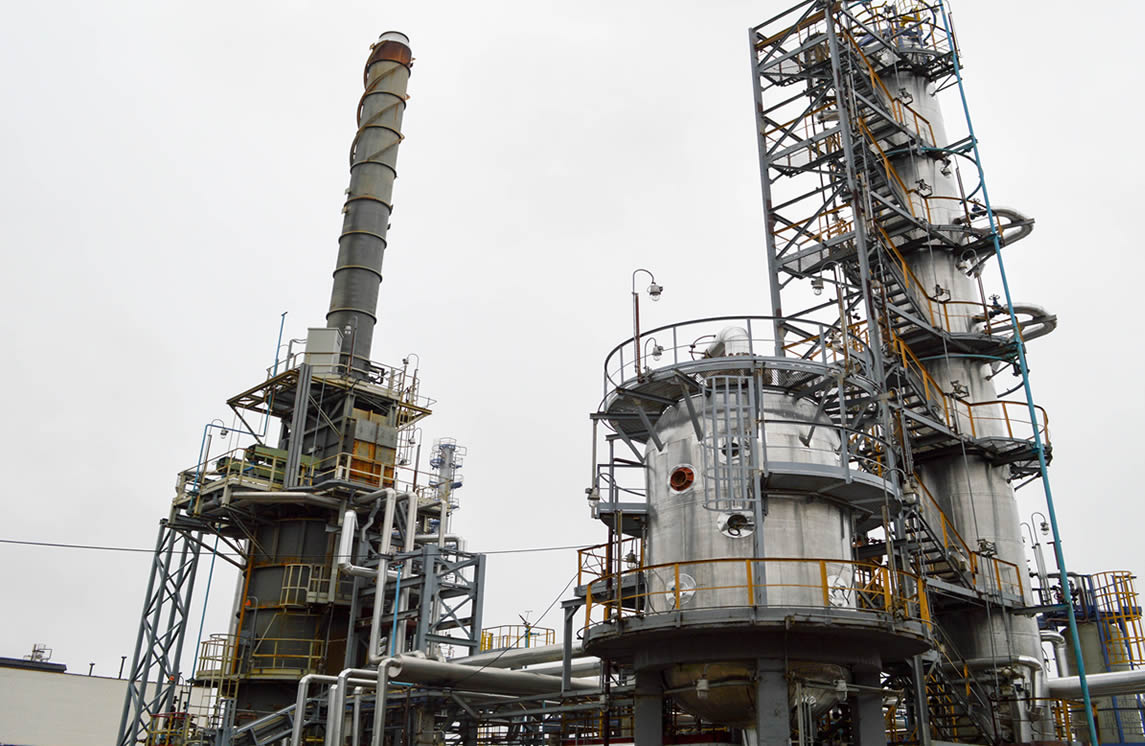
Oil Refining
Redefining and modernizing oil refining facilities is currently the primary technological obstacle in the oil refining industry. This is a challenge that all oil companies in Kazakhstan are currently facing. PETROLQUALITY TOO, as part of a national project, is taking steps to establish new catalyst production facilities, innovate with unique technology, and enhance safety measures in order to produce high-performance and environmentally-friendly gasoline.
Refining
By the conclusion of 2023, the Company possesses two prominent oil refineries located strategically in Kazakhstan, along with three petrochemical and four gas processing plants, in addition to two catalyst production plants. The combined planned capacity of Kazakhstan's primary oil refineries is 118.3 million tons of oil annually.
Developing New Kinds Of Catalysts
All secondary refining processes necessitate the utilization of catalysts. PETROLQUALITY TOO is the sole oil company in the CIS region that possesses its own production facilities for catalytic-cracking catalysts, which has a yearly capacity of 3,000 tonnes. Nevertheless, this quantity is only sufficient to meet the requirements of the company's own refineries. The majority of other oil refining facilities in Kazakhstan acquire their catalysts from foreign sources, and catalysts for hydro-processing (hydrocracking and hydrotreating) are predominantly imported.

Basin Modelling
Prospecting for new oil reserves is an intricate and expensive process, especially when exploring unexplored and hard-to-reach areas. However, utilizing basin modeling can help reduce uncertainties and costs associated with geological prospecting. Basin modeling uses mathematical and analytical techniques to recreate the geological history of a region, allowing for a better understanding of how hydrocarbon deposits have formed and evolved over time. By analyzing all available geological data, basin modeling can provide valuable insights into potential oil-rich areas, helping streamline the prospecting process and minimizing expensive mistakes.
Rotary Steerable Systems (RSS)
Rephrased: Specialist equipment is required for the construction of high-technology wells. The foundation for modern, efficient, accurate, and safe drilling methods is rotary steerable systems (RSS). RSS enables the drilling of wells with precise deflection angles and minimal displacement, including horizontal wells of over 2,000 meters in length. By utilizing RSS, it is possible to construct wells with extreme reach and drill with high precision in low-concentration reservoirs that are only one to two meters thick.
Drilling
Approximately 70 percent of PETROLQUALITY TOO's project portfolio consists of difficult-to-recover reserves. These include leftover deposits in exhausted fields and reservoirs with low concentration and low porosity. To tap into these reserves, the company is utilizing advanced horizontal and multilateral wells, employing state-of-the-art downhole equipment and remote online monitoring technology. They are also implementing organizational technologies to improve the drilling process and reduce expenses.
Remote Controlled Drilling
The purpose of establishing the Drilling Support Centre at PETROLQUALITY TOO is to enhance the efficiency of constructing advanced wells. The centre primarily focuses on geo-steering technology, which involves monitoring and adjusting the well's path in real time based on geological information. Through the use of advanced telecommunications technology, real-time data is transmitted to the centre during drilling. This data is then compared to projected data on the existing geological model, analyzed, and used to make necessary corrections to the well trajectory to ensure it stays within the target zone. This iterative process allows for continuous monitoring and control over drilling operations.
Products
The refinery products have obtained certification in accordance with the technical regulations for automobile and aviation gasoline, diesel oil, jet propulsion fuel, and residual fuel oil, as well as the relevant State Standards (GOSTs). Any oil products that do not require mandatory certification have the option to be certified voluntarily.
Competent staff from the chemical analytical laboratory, accredited for technical competence in the system of accreditation of analytical laboratories, and in possession of a certificate issued by the Federal Agency on Technical Regulating and Metrology, are responsible for controlling the quality of crude oil and oil products throughout the production and shipment process.
Products of PETROLQUALITY TOO
Aromatic hydrocarbons
- Toluene oil (GOST 14710-78)
- Petroleum benzine (GOST 9572-93)
Ammonia
- Ammonia anhydrous liquefied. Specifications (GOST 6221-90)
Petrol
- Automobile petrol unleaded brand “AI-80” (GOST 32513-2013)
- Automobile petrol unleaded brand “AI-92” (GOST 32513-2013)
- Automobile petrol unleaded brand “AI-95” (GOST 32513-2013)
- Automobile petrol unleaded brand “AI-98” (GOST 32513-2013)
- Automobile petrol unleaded brand “Normal-80” (GOST R 51105-97)
- Automobile petrol unleaded brand “Regular-92” (GOST R 51105-97)
- Gasoline unleaded brand “Premium Euro-95” (GOST R 51866-2002)
- Gasoline unleaded brand “Super Euro-98” (GOST R 51866-2002)
- Petrol for industrial purposes (STO 05766480-006-2010)
- Stable reformat (TU 19.20.23.190-40-05755480-2017)
Diesel fuel
- Fuel diesel EURO (GOST 32511-2013)
- Fuel diesel (SRT 05766480-010-2011)
- Fuel diesel EURO (GOST R 52368-2005)
- Vacuum gas oil (TU 38.1011304-2004)
Kerosene
- Aviation fuel for gas turbine engines JET A-1 (GOST R 52050-2006)
- Fuel for jet engines (GOST 10227-86)
Oxygen
- Oxygen technical (GOST 5583-78)
Fuel oil
- Fuel oil (GOST 10585-2013)
- Technological Export Fuel (TU 38.001361-99)
Oil bitumen
- Bitumens petroleum insulating (GOST 9812-74)
- Bitumens petroleum road viscous (GOST 22245-90)
- Bitumens petroleum road improved from the West Siberian oils (TU 0256-096-00151807-97)
- Oil bitumen for the production of roofing and waterproofing materials (TU 0256-017-05766480-2003)
- Bitumens petroleum construction (GOST 6617-76)
- Bitumens petroleum road viscous (GOST 33133-2014)
Solvents
- Nefras-S 50/170 (GOST 8505-80)
- Solvent of oil superheavy (TU 38.1011049-98)
Sulfur technical
- Technical sulfur (GOST 127.1-93)
- Sulfur technical gas granulated. Technical conditions (STO 05766480-008-2011)
Sulfuric technical acid
- Sulfuric technical acid (GOST 2184-2013)
Liquefied gases
- Gases hydrocarbon liquefied fuel for municipal consumption (GOST 20448-90)
- Normal butane (SRT 05766480-005-2010)
- Isobutane (SRT 05766480-004-2010)
- Gases hydrocarbon liquefied fuel (GOST R 52087-2003)
Commercial xylenes
- Paraxylene (TU 38.101255-87)
- Orthoxylene (TU 38 101254-72)
Ship fuel
- High-viscosity marine fuel E (TU 38.1011314-2001)

Atmospheric Refining Unit (АТ-1):
- Nameplate capacity (1998): 0.5 MTPA;
- Post-upgrading nameplate capacity (2002): 0.65 MTPA;
- Technological Process Designer: Oil Tools Engineering Services (Singapore);
- General Design Engineer: Baltneftegazservice (Kazan, the Republic of Tatarstan)
Atmospheric Residue Vacuum Distillation Unit:
- Nameplate capacity (2005): 0.47 MTPA;
- Post-upgrading nameplate capacity (2010): 0.6 MTPA;
- Technological Process Designer: Institute of Refinery Processing of the Republic of Bashkortostan, a State-Owned Unitary Enterprise;
- General Design Engineer: Baltneftegazservice (Kazan, the Republic of Tatarstan).
Atmospheric Refining Unit (АТ-2):
- Nameplate capacity (2007) – 0.9 MTPA;
- Technological Process Designer: KOCH-GLITSCH (Czech Republik);
- General Design Engineer: Baltneftegazservice (Kazan, the Republic of Tatarstan)